Insertional Achilles Debridement (spur removal) and Repair
-
Eitan Ingall, MD Fellowship Trained Orthopaedic Surgeon
Dr. Ingall is a fellowship-trained orthopedic foot and ankle surgeon who prides himself on delivering compassionate, evidence-based care to his patients.
What is Insertional Achilles Debridement (spur removal) and Repair?
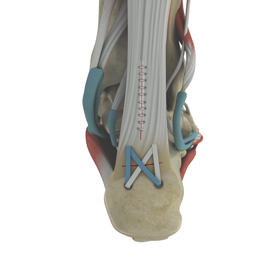
Insertional Achilles debridement and repair is a surgical procedure performed to address chronic pain and dysfunction at the insertion point of the Achilles tendon where it attaches to the calcaneus (heel bone). This pain is often caused by insertional Achilles tendinopathy, which may involve the formation of bone spurs, tendon degeneration, and inflammation.
Tendons are the soft tissues connecting muscle to bone. The Achilles tendon is the longest tendon in the body and is present behind the ankle, joining the calf muscles with the heel bone. Contraction of the calf muscles tightens the Achilles tendon and pulls the heel, enabling the foot and toe movements necessary for walking, running, and jumping.
Indications for Insertional Achilles Debridement (spur removal) and Repair
Insertional Achilles debridement (spur removal) and repair are typically recommended when:
- Conservative treatments such as physical therapy, anti-inflammatory medications, or extracorporeal shockwave therapy have failed to relieve symptoms
- There is persistent pain that limits mobility or activity
- Imaging studies such as X-rays and MRI show:
- Degeneration of the Achilles tendon
- The presence of bone spurs causing irritation or inflammation
- Calcification within the tendon
Preparation for Insertional Achilles Debridement (spur removal) and Repair
In general, preparation for insertional Achilles debridement and repair may include the following steps:
- A comprehensive medical evaluation, including a review of your medical history, physical examination, and laboratory studies such as blood testing to assess the patient’s suitability for the procedure
- Preoperative X-rays and MRI scans to confirm the presence of calcaneal bone spurs and assess the extent of Achilles tendon damage
- Informing your doctor of any allergies to medications, anesthesia, or latex
- Providing your physician with a list of any medications or supplements you are taking
- You may need to adjust or temporarily stop taking certain medications or supplements - especially those that can affect blood clotting
- Stopping smoking, as it can negatively impact the healing process and increase the risk of complications
- Abstaining from food or drink for at least 8 hours prior to surgery
Procedure for Insertional Achilles Debridement (spur removal) and Repair
The procedure for insertional Achilles debridement (spur removal) and repair is typically performed under regional or general anesthesia and involves the following steps:
- The patient is positioned face down (prone) or on their side to provide optimal access to the back of the heel.
- A longitudinal incision or a curved incision is made along the back of the heel to expose the Achilles tendon and the area where it inserts into the calcaneus.
- Soft tissue is carefully dissected to expose the Achilles tendon and calcaneal bone spur.
- Damaged or degenerated portions of the Achilles tendon are carefully removed (debridement), leaving as much healthy tissue as possible. Surrounding inflamed or fibrotic tissue is removed as well.
- The calcaneal bone spur is removed using a high-speed burr or osteotome. The surgeon smooths the area to reduce the risk of future irritation.
- If only a small portion of the tendon is debrided, the remaining tendon may simply be sutured together.
- For significant tendon damage, the surgeon may reinforce the repair with a tendon graft, often harvested from nearby tissues like the flexor hallucis longus (FHL) tendon.
- If the tendon is detached for access, it will be reattached to the heel bone using bone anchors or similar fixation devices.
- The incision is closed with sutures or staples, and a sterile dressing is applied.
Post-Procedure Care and Recovery
After the surgery, the patient is typically monitored in the recovery room before being discharged usually the same day or after a short hospital stay. A splint, cast, or walking boot is used to immobilize the foot for 4-6 weeks to protect the repair and for proper healing. Non-weight-bearing is typically required initially, with gradual progression to partial and then full weight-bearing as advised by the surgeon. Physical therapy begins once healing is sufficient, often 6-8 weeks post-surgery, and includes range-of-motion, strengthening, and functional exercises. Pain and inflammation are managed with prescribed medications and icing. Full recovery may take 6-12 months, during which adherence to rehabilitation protocols is crucial to achieving optimal outcomes. Regular follow-ups are scheduled to monitor healing and progress.
Risks and Complications
Insertional Achilles debridement (spur removal) and repair is generally a safe procedure, but like all surgeries, it carries risks and potential complications. These include:
- Heel pain or swelling
- Infection
- Bleeding
- Delayed tendon or wound healing
- Tendon re-tear or weakness
- Nerve damage
- Stiffness and limited mobility
- Blood clots or deep vein thrombosis (DVT)
For more information about our services or to schedule an appointment, call us at or click here to request an appointment online. We'll respond to you as soon as possible.